The Interaction between Mathematical Problem-Solving Skills and Mathematical Communication Skills of Junior High School Students: A Qualitative Approach
DOI:
https://doi.org/10.32939/ejrpm.v8i2.5828Keywords:
Assessment, Case Study, Mathematical Communication Skills, Mathematical Problem-Solving SkillsAbstract
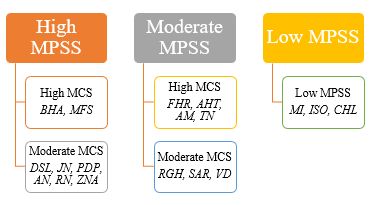
Mathematical problem-solving skills (MPSS) and mathematical communication skills (MCS) has a very close relationship. Before solving a problem, students should understand the problem first, processing and presenting their answer, which is a MCS. Different from the previous study, this study reveal the relationship and interaction between students’ MPSS and MCS using a qualitative approach. To do this, a case study method is conducted using valid test and interviews. The test consist of three cases: smartphone storage, riddle about number of chickens and the coop, and area of land to be planted with corn. The participants of this study were eighth-grade 18 students from various junior high scholl and region in West Sumatra. Data analysis used is a descriptive analysis of students' test answers and interview results. The results show that there are five of nine interactions between MPSS and MCS: solver, self-solver, sharer, regular, and receiver. Solver is a student with high MPSS and MCS (2 students), self solver is a student with high MPSS but moderate MCS (6 students), sharer is a student with moderate MPSS but high MCS (4 students), regular is a student with moderate MPSS and MCS (3 students), and receiver is a student with low MPSS and MCS (3 students). The results of this study also show that the relationship between MPSS and MCS is very close. Although there are students who have MPSS and MCS that do not match, this is inseparable from the limitations of the research conducted.
Downloads
References
Al Mahrouq, Y. A. (2016). Effect of item difficulty and sample size on the accuracy of equating by using item response theory. Journal of Educational and Psychological Studies [JEPS], 10(1). https://doi.org/10.53543/jeps.vol10iss1pp182-200
Ariawan, R., & Nufus, H. (2017). Hubungan kemampuan pemecahan masalah matematis dengan komunikasi matematis siswa. Jurnal THEOREMS (The Original Research of Mathematics), 1(2), 82-91. https://media.neliti.com/media/publications/301729-hubungan-kemampuan-pemecahan-masalah-mat-598f71e9.pdf
Aripin, U., Rosmiati, T., Pitriyani, W., & Fauzi, F. (2024). Solving smartphone storage management problems: Students’ mathematical literacy based on self-regulated learning. Edumatika : Jurnal Riset Pendidikan Matematika, 7(1), 31-44. https://doi.org/10.32939/ejrpm.v7i1.3614
Bal, A. P., & Artut, P. D. (2022). Investigation of primary school students solving arithmetic verbal problems. Journal of Education and Learning (EduLearn), 16(1), 76-84. https://doi.org/10.11591/edulearn.v16i1.20336
Cote, C. (2023). Why Problem-Solving Skills Are Essential for Leaders. Harvard Business School Online.
Fatimah, F. (2013). Kemampuan komunikasi matematis dan pemecahan masalah melalui problem based-learning. Jurnal Penelitian dan Evaluasi Pendidikan, 16(1), 249-259. https://doi.org/10.21831/pep.v16i1.1116
Fitri, P. R., & Pujiastuti, H. (2020). Pengaruh kemampuan komunikasi matematis terhadap kemampuan pemecahan masalah pada siswa SMP kelas 9. Jurnal Ilmiah Pendidikan Matematika Al Qalasadi, 4(1), 1–6. https://doi.org/10.32505/qalasadi.v4i1.1672
Fitzpatrick, A. R., & Yen, W. M. (2001). The Effects of Test Length and Sample Size on the Reliability and Equating of Tests Composed of Constructed-Response Items. Applied Measurement in Education, 14(1), 31-57. https://doi.org/10.1207/S15324818AME1401_04
Groves, T., & Robinson, W. (2024). Distilling the comparative essence of teachers’ centres in England and Spain 1960-1990: past perspectives and current potential for teacher professional development? Research Papers in Education, 39(1), 93-112. https://doi.org/10.1080/02671522.2022.2089215
Gunawan, I., Darhim, D., & Kusnandi, K. (2019, February). Exploration of the behavior of understanding mathematical concepts of junior high school students. In Journal of Physics: Conference Series (Vol. 1157, No. 4, p. 042098). IOP Publishing. https://doi.org/10.1088/1742-6596/1157/4/042098
Harisman, Y., Mayani, D. E., Armiati, Syaputra, H., & Amiruddin, M. H. (2023). Analysis of student’s ability to solve mathematical literacy problems in junior high schools in the city area. Infinity Journal, 12(1), 55-68. https://doi.org/10.22460/infinity.v12i1.p55-68
Harisman, Y., Noto, M. S., & Hidayat, W. (2021). Investigation of students’ behavior in mathematical problem solving. Infinity Journal, 10(2), 235-258. https://doi.org/10.22460/infinity.v10i2.p235-258
Harun, L., Darhim, D., Dahlan, J. A., Harisman, Y., Sovia, A., & Bakar, M. T. (2019, February). Students’ gesture of naive, routine, and shopisticated behavior oriented on mathematical problem solving. In Journal of Physics: Conference Series (Vol. 1157, No. 4, p. 042074). IOP Publishing. https://doi.org/10.1088/1742-6596/1157/4/042074
Junsay, M. (2016). Reflective learning and prospective teachers’ conceptual understanding, critical thinking, problem solving, and mathematical communication skills. Research in Pedagogy, 6(2), 43-58. https://doi.org/10.17810/2015.34
Khumainah, N. D. Z., Ulum, A. M., Fitriani, H., & Fa’ani, A. M. (2025). Truth-seeking behavior of prospective mathematics teachers in solving islamic-integrated problems with contradictory information (PWCI): A mathematical resilience perspective. Edumatika : Jurnal Riset Pendidikan Matematika, 8(1), 1–20. https://doi.org/10.32939/ejrpm.v8i1.4341
Laia, S., & Surven. (2023). Relationship between mathematical problem solving ability & mathematical communication ability of grade VII students at SMP Negeri 2 academic year 2022/2023. AFORE : Jurnal Pendidikan Matematika, 1(2), 24-32. https://doi.org/10.57094/afore.v1i2.571
Le Roux, N., & Sebolai, K. (2017). The national benchmark test of quantitative literacy: Does it complement the grade 12 mathematical literacy examination? South African Journal of Education, 37(1), 1-11. https://doi.org/10.15700/saje.v37n1a1350
Le, C. V., Pardos, Z. A., Meyer, S. D., & Thorp, R. (2018, June). Communication at scale in a MOOC using predictive engagement analytics. In International Conference on Artificial Intelligence in Education (pp. 239–252). Cham: Springer International Publishing. https://doi.org/10.1007/978-3-319-93843-1_18
Marniati, M., Jahring, J., & Jumriani, J. (2021). Analisis kemampuan komunikasi matematis siswa dalam memecahkan masalah berdasarkan motivasi belajar siswa. AKSIOMA: Jurnal Program Studi Pendidikan Matematika, 10(2), 880-890. https://doi.org/10.24127/ajpm.v10i2.3523
Martins, L. G., & Martinho, M. H. (2021). Strategies, difficulties, and written communication in solving a mathematical problem. Bolema: Mathematics Education Bulletin, 35(70), 903-936. https://doi.org/10.1590/1980-4415v35n70a16
Muir, T., Beswick, K., & Williamson, J. (2008). “I’m not very good at solving problems”: An exploration of students’ problem solving behaviours. The Journal of Mathematical Behavior, 27(3), 228–241. https://doi.org/10.1016/J.JMATHB.2008.04.003
Musdi, E., Syaputra, H., Arnellis, & Harisman, Y. (2024). Students’ mathematics communication behavior: Assessment tools and their application. Journal on Mathematics Education, 15(1), 317–338. https://doi.org/10.22342/jme.v15i1.pp317-338
Nasrullah, A., Mubarika, M. P., & Umalihayati. (2023). Distance learning: GeoGebra-learning videos to improving mathematical communication ability. International Journal of Emerging Technologies in Learning, 18(16), 115-129. https://doi.org/10.3991/ijet.v18i16.42173
NCTM. (2000). Executive Summary: Principles and Standards for School Mathematics. https://www.nctm.org/uploadedFiles/Standards_and_Positions/PSSM_ExecutiveSummary.pdf
Neria, D., & Amit, M. (2004). Students preference of non-algebraic representations in mathematical communication. In Proceedings of the 28th Conference of the International Group for the Psychology of Mathematics Eduation (Vol. 3, pp. 409-416). https://eric.ed.gov/?id=ED489599
Ningtyas, E. Z. (2021). Mathematics communication junior high school students in solving open-ended question based on reflective-impulsive cognitive style. EduTeach : Jurnal Edukasi dan Teknologi Pembelajaran, 2(1), 31-41. https://doi.org/10.37859/eduteach.v2i1.2410
Nufus, H., & Mursalin, M. (2020). Improving students’ problem solving ability and mathematical communication through the application of problem based learning. Electronic Journal of Education, Social Economics and Technology, 1(1), 43-48. https://doi.org/10.33122/ejeset.v1i1.8
Nursoffina, M., & Efendi, N. (2021). Analysis of the relationship between mathematical reasoning and problem solving of elementary students mathematics material. Academia Open, 6. https://doi.org/10.21070/acopen.6.2022.1813
OECD. (2023). PISA 2022 Assessment and Analytical Framework. OECD. https://doi.org/10.1787/dfe0bf9c-en
Prabawanto, S., Utami, N. S., & Pebrianti, A. (2023). Assessing students’ mathematical problem-solving ability. AKSIOMA: Jurnal Program Studi Pendidikan Matematika, 12(2), 1965-1975. https://doi.org/10.24127/ajpm.v12i2.7346
Prasad, M. (2021). Pragmatism as problem solving. Socius, 7, 1-13. https://doi.org/10.1177/2378023121993991
Pratama, T. C., Kartika, H., & Aini, I. N. (2017). Hubungan kemampuan pemecahan masalah dengan kemampuan komunikasi matematis. In Prosiding Seminar Nasional Matematika dan Pendidikan Matematika (SESIOMADIKA) (p. 668–679). https://pmat-unsika.eu5.org/Prosiding/98TopanCiptaP-SESIOMADIKA-2017.pdf
Puspa, S., Riyadi, R., & Subanti, S. (2019, February). Profile of mathematical communication skills junior high school students in problem solving. In Journal of Physics: Conference Series (Vol. 1157, No. 3, p. 032125). IOP Publishing. https://doi.org/10.1088/1742-6596/1157/3/032125
Putri, N. D., & Musdi, E. (2020, May). Analysis of students Initial mathematical communication skills in mathematics learning. Journal of Physics: Conference Series (Vol. 1554, No. 1, p. 012064). IOP Publishing. https://doi.org/10.1088/1742-6596/1554/1/012064
Rohati, R., Kusumah, Y. S., & Kusnandi, K. (2022). The development of analytical rubrics: An avenue to assess students’ mathematical reasoning behavior. Cypriot Journal of Educational Sciences, 17(8), 2553-2566. https://doi.org/10.18844/cjes.v17i8.7043
Rohati, R., Kusumah, Y. S., & Kusnandi, K. (2023). Exploring students’ mathematical reasoning behavior in junior high schools: A grounded theory. Education Sciences, 13(3), 252. https://doi.org/10.3390/educsci13030252
Rohid, N., Suryaman, S., & Rusmawati, R. D. (2019). Students’ mathematical communication skills (MCS) in solving mathematics problems: A case in Indonesian context. Anatolian Journal of Education, 4(2), 19–30. https://doi.org/10.29333/aje.2019.423a
Rohmah, A. N., Sari, I. J., Rohmah, N. L., Syafira, R., Fitriana, F., & Admoko, S. (2023). Implementation of the “Merdeka Belajar” curriculum in the industrial 4.0 era. International Journal of Research and Community Empowerment, 1(1), 22-28. https://doi.org/10.58706/ijorce.v1n1.p22-28
Rusyda, N. A., Ahmad, D., Rusdinal, R., & Dwina, F. (2020, May). Analysis of students’ mathematical communication skill in calculus course. In Journal of Physics: Conference Series (Vol. 1554, No. 1, p. 012043). IOP Publishing. https://doi.org/10.1088/1742-6596/1554/1/012043
Sari, S. I., & Yuberta, K. R. (2022). Analysis of mathematical communication ability in terms of student’s numerical ability. Rangkiang Mathematics Journal, 1(2), 81-90. https://doi.org/10.24036/rmj.v1i2.7
Septriansyah, A., Imamuddin, M., Apriyanti, D., & Pelitawaty, M. D. (2022). Students’ mathematical problem solving skills in solving HOTS problems. Edumatika : Jurnal Riset Pendidikan Matematika, 5(2), 134-144. https://doi.org/10.32939/ejrpm.v5i2.1604
Sumadi, I. P., & Kusdinar, U. (2019). The relation of mathematical communication and learning motivation to students’ problem-solving skills. AdMathEduSt: Jurnal Ilmiah Mahasiswa Pendidikan Matematika, 6(2), 86–92. https://journal.uad.ac.id/index.php/AdMathEdust/article/view/18820
Syafri, F. S., Isran, D., & Nurhikma. (2021, March). The relationship between mathematical problem-solving ability, mathematical connection ability, and ability to read the Qur’an. In Proceedings of the International Conference on Educational Sciences and Teacher Profession (ICETeP 2020) (pp. 186-191). Atlantis Press. https://doi.org/10.2991/assehr.k.210227.033
Tupamahu, P. Z., Ratumanan, T. G., & Laamena, C. (2023). Students’ mathematical representation and communication ability in mathematics problem solving. Jurnal Didaktik Matematika, 10(1), 111-130. https://doi.org/10.24815/jdm.v10i1.29376
Wahyuningrum, E., & Suryadi, D. (2014). Association of mathematical communication and problem solving abilities: Implementation of MEAs strategy in junior high school. SAINSAB, 17(1), 38-50. https://repository.ut.ac.id/4580/1/2015-dn-012-endangw.pdf
Waswa, D. W., & Al-Kassab, M. M. (2023). Mathematics learning challenges and difficulties: A students’ perspective. In Springer Proceedings in Mathematics & Statistics (Vol. 418, pp. 311-323). https://doi.org/10.1007/978-981-99-0447-1_27
Wulansari, I., & Walid, W. (2021). Analysis of students mathematics communication ability based on Keirsey personality type through accelerated learning model. Unnes Journal of Mathematics Education, 10(2), 99-106. https://doi.org/10.15294/ujme.v10i2.32178
Downloads
Published
Issue
Section
License
Copyright (c) 2025 Hamdani Syaputra, Armiati Armiati, Yulyanti Harisman

This work is licensed under a Creative Commons Attribution 4.0 International License.