Students’ Obstacles and Difficulties in Mathematical Literacy Based on Skill Levels and Learning Styles
DOI:
https://doi.org/10.32939/ejrpm.v8i2.6144Keywords:
Cognitive Difficulties, Learning Styles, Mathematical Literacy, Student ObstaclesAbstract
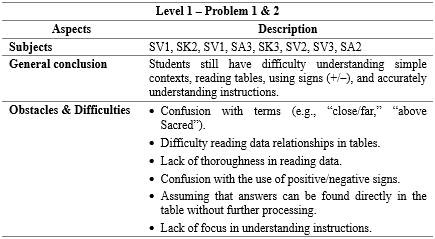
This study aims to analyze the variations in students' obstacles and difficulties in mathematical literacy across different skill levels and learning styles. Through qualitative research with a phenomenological approach, the subject selected using purposive sampling. This research involved nine students of a junior high school in Bandung, Indonesia, each representing three learning styles (visual, auditory, and kinesthetic) and three levels of mathematical literacy (high, medium, and low). Data were analyzed using data reduction, data presentation, and conclusion drawing. The findings relveal that students' obstacles and difficulties in mathematical literacy varie based on their skill levels and learning styles. Students with moderate and low skills commonly experience difficulties in understanding context, processing information, creating mathematical models, and arguing and evaluating solutions. Differences in learning styles also determine the types of obstacles and difficulties that arise: visual students have difficulty in understanding verbal information, auditory students have difficulty in interpreting symbols and visual representations without verbal explanations, and kinesthetic students need concrete experiences to understand abstract concepts. These findings emphasize the importance of adjusting learning strategies so that all stages of mathematical literacy can develop optimally for all students with varie learning styles.
Downloads
References
Not yet available.
Downloads
Published
Issue
Section
License
Copyright (c) 2025 Irma Amelia, Tatang Herman, Lukman Lukman

This work is licensed under a Creative Commons Attribution 4.0 International License.