Learners’ Translation Ability Within and Among Representations when Solving Trigonometric Equations
DOI:
https://doi.org/10.32939/ejrpm.v9i1.6787Keywords:
Mathematical Representation, Problem-Solving, Translation Ability, Trigonometric EquationsAbstract
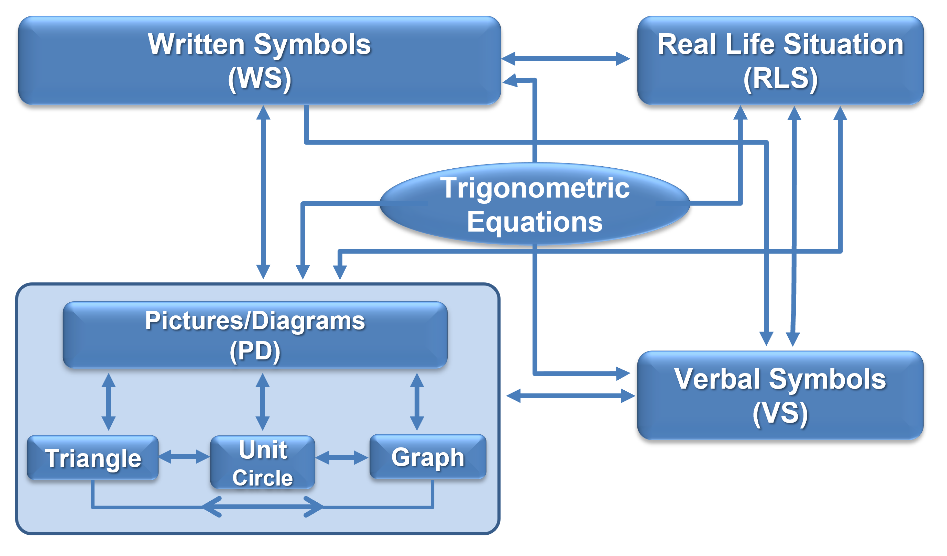
Background: Trigonometry remains a persistent challenge for many learners, particularly when translating within and among different representations (DR) when solving trigonometric equations. While translation of representations is widely studied, limited research has examined how learners translate within and among DR specifically when solving trigonometric equations. Purpose: This study aims to explore learners’ translation ability within and among DR when solving trigonometric equations. Method: A qualitative case study design within an interpretive paradigm was conducted involving 63 Grade 11 learners, purposively selected in Mogalakwena, Limpopo, South Africa. Data was collected through learners’ written class works responses and task-based interviews and analysed using inductive thematic analysis guided by the Multiple Representations Translations Theory. Findings: Many learners relied predominantly on symbolic representation and lack the ability to translate skills within and among diagrammatic, verbal, and real-life representations, leading to fragmented reasoning and incorrect solutions. Implications: The study recommends that when teachers facilitate learning on solving trigonometric equations, they should not focus on one representation, as the ability to translate within and among DR is a critical threshold for conceptual understanding. Originality: This study provides empirical insight of how learners translate within and among DR in solving trigonometric equations.
Downloads
References
Not yet available.
Published
Issue
Section
License
Copyright (c) 2026 Livhalani Dau, Kgaladi Maphutha, Paul Mutodi, Satsope Maoto

This work is licensed under a Creative Commons Attribution 4.0 International License.